
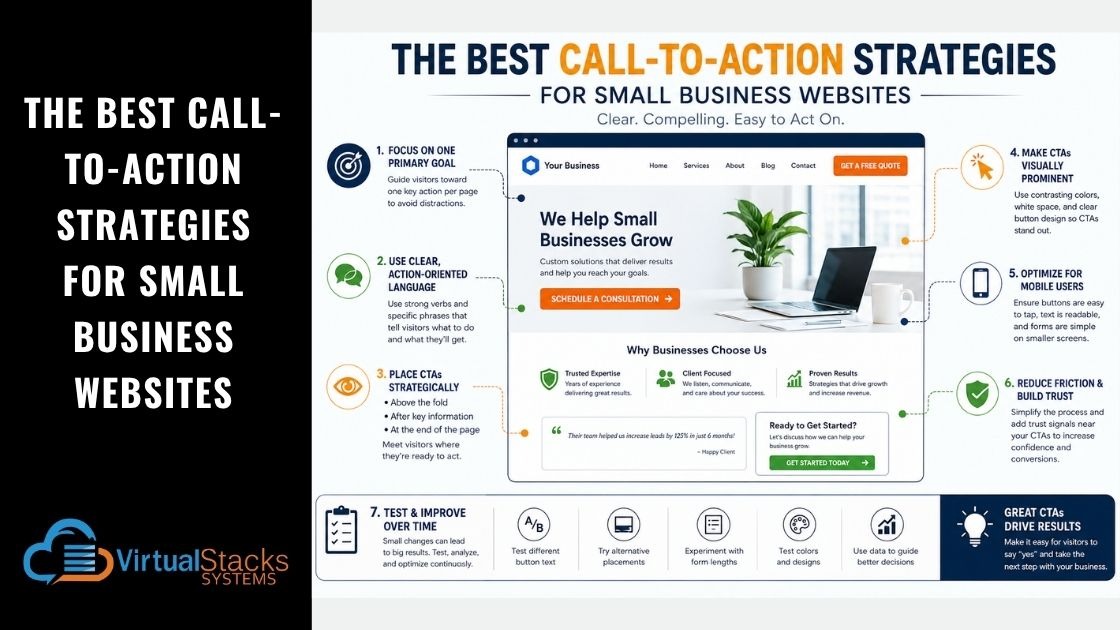
09 Jun The Best Call-to-Action Strategies for Small Business Websites

You can invest in professional web design, create helpful content, and drive traffic to your website through SEO and advertising. But if visitors don’t know what to do next, all that effort may fail to generate leads and sales.
That’s where calls to action (CTAs) come in.
A call to action is any button, link, form, or prompt that encourages visitors to take a specific action — such as requesting a quote, scheduling a consultation, downloading a guide, or making a purchase. Effective CTAs guide visitors through the customer journey and help transform website traffic into real business opportunities.
If your small business website isn’t generating the results you expect, improving your CTAs may be one of the fastest ways to increase conversions.
Focus on One Primary Goal Per Page
One of the most common mistakes on small business websites is presenting too many options at once.
When visitors are faced with multiple competing actions, they often choose none of them. Instead, each page should have one primary objective and one primary CTA that supports it.
For example:
- Service page: “Request a Free Quote”
- Consultation page: “Schedule a Consultation”
- Product page: “Buy Now”
- Contact page: “Get Started”
Secondary actions can still be available, but they should not compete visually with the primary CTA.
Use Clear, Action-Oriented Language
Visitors should immediately understand what will happen when they click a button.
Generic phrases such as “Submit” or “Click Here” provide little motivation. Strong CTAs use action verbs and communicate value.
Examples include:
- Schedule Your Free Consultation
- Get a Custom Quote
- Download the Guide
- Start Your Project
- Claim Your Free Estimate
- Book Your Appointment
The more specific the CTA, the easier it is for visitors to make a decision.
Highlight the Benefit
The most effective CTAs focus on what the customer gains, not what the business wants.
Compare these examples:
Weak CTA:
- Contact Us
Stronger CTA:
- Get Expert Advice Today
Weak CTA:
- Submit
Stronger CTA:
- Get My Free Estimate
Benefit-driven language helps visitors understand why taking action is worth their time.
Place CTAs Where Visitors Are Ready to Act
Many websites place a CTA only in the navigation menu or footer. However, visitors make decisions at different stages of the browsing experience.
For best results, include CTAs in multiple strategic locations:
Above the Fold
Your primary CTA should be visible without requiring users to scroll. Visitors should immediately know how to contact you or take the next step.
After Key Information
Place CTAs after sections that build trust, such as:
- Customer testimonials
- Case studies
- Service descriptions
- Pricing information
These sections answer questions and reduce uncertainty, making visitors more likely to convert.
At the End of Each Page
Visitors who reach the bottom of a page are often highly engaged. Ending with a strong CTA provides a natural next step.
Make CTAs Visually Prominent
A CTA can’t generate results if visitors don’t notice it.
Your buttons should stand out from surrounding content through:
- Contrasting colors
- Adequate white space
- Readable text
- Sufficient button size
- Consistent styling throughout the website
The goal isn’t to make CTAs flashy or distracting. The goal is to make them easy to find and understand. Our blog post — “X Marks the Spot: Creating Call-to-Action Buttons that Get Leads” — covers this essential topic in detail.
Optimize for Mobile Users
Mobile traffic now represents a significant percentage of website visits for most small businesses. A CTA that works well on a desktop computer may be difficult to use on a smartphone.
Mobile-friendly CTAs should:
- Be large enough to tap easily
- Include sufficient spacing around buttons
- Remain visible without excessive scrolling
- Use concise, readable text
Businesses should test CTAs on multiple devices to ensure a smooth user experience.
Reduce Friction Whenever Possible
Every additional step can reduce conversion rates. If your CTA leads to a lengthy form asking for excessive information, visitors may abandon the process.
Whenever possible:
- Ask only for essential information
- Simplify forms
- Explain what happens next
- Remove unnecessary obstacles
For example, “Request a Free Quote” may perform better when paired with reassurance such as:
“No obligation. We’ll respond within one business day.”
Reducing uncertainty helps build confidence.
Use Trust Signals Near CTAs
Visitors are more likely to take action when they feel confident in your business.
Consider placing trust-building elements near your CTAs, such as:
- Customer reviews
- Testimonials
- Industry certifications
- Awards
- Years in business
- Guarantees
These elements reinforce credibility at the exact moment visitors are deciding whether to contact you.
Test and Improve Over Time
Even small changes to CTA copy, placement, or design can significantly impact conversion rates.
Consider testing:
- Different button text
- Alternative page placements
- Various form lengths
- Different colors and layouts
- Benefit-focused versus action-focused messaging
Rather than guessing what works best, use data to guide improvements.
The Take-Home Message and Our Blatant Self-Promotion
A well-designed website should do more than attract visitors — it should guide them toward becoming customers.
The best calls to action are clear, visible, relevant, and easy to complete. By focusing on one primary goal per page, using action-oriented language, strategically placing CTAs throughout your site, and continually testing improvements, small businesses can dramatically increase the number of leads and sales their websites generate.
If your website is receiving traffic but not producing results, your calls to action may be the first place to look. Now, here’s our call to action! You’re too busy running your business to take on website design and website marketing in-house. Our dedicated Virtual Stacks Systems team provides comprehensive digital marketing services that include website design, website redesign, pay-per-click marketing, SEO services, content writing and so much more! Every small business is unique, and so are our solutions. We are ready to be your partner in success!
Contact us to learn more and get started!