
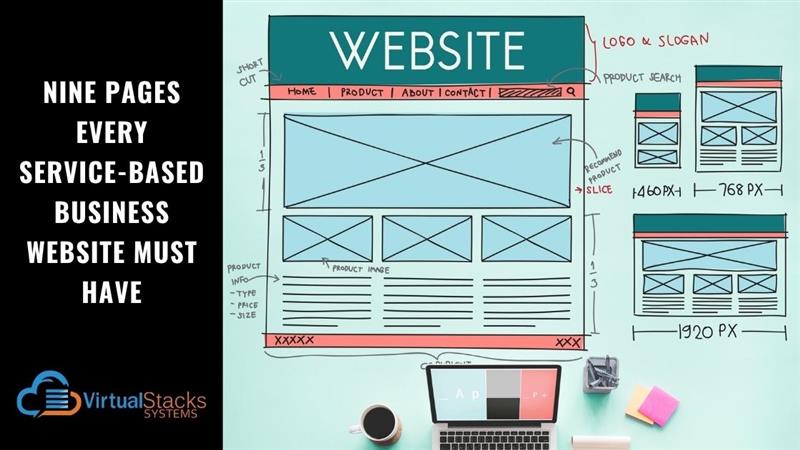
09 Apr Nine Pages Every Service-Based Business Website Must Have
Your website is often the first impression potential customers have of your business. But it’s not just about looking good — it needs to guide visitors, build trust and convert leads into paying customers.
One of the biggest mistakes service-based businesses make is either missing essential pages, or overloading their website with unnecessary ones.
So what pages do you actually need?
Here’s a breakdown of the must-have website pages every service-based business should include to maximize visibility, credibility and conversions.
1. Home Page: Your First Impression
Your home page should clearly answer three questions within seconds:
- What do you do?
- Who do you help?
- Why should someone choose you?
A strong home page includes:
- A clear headline and value proposition
- Brief overview of services
- Trust signals (reviews, certifications, years of experience)
- A strong call-to-action (CTA)
Think of your home page as a guided introduction, not a deep dive. As Little Mountain Printing notes, “Your homepage is a map, not a brochure.”
2. Services Pages: Where Conversions Happen
Your services pages are the core of your website — and where most conversions occur.
Instead of listing all services on one page, create individual pages for each service. This helps with both SEO and user experience. Moreover, individual service pages make it easier to rank in search engines and run targeted PPC campaigns through platforms like Google Ads.
Each service page should include the following:
- A clear explanation of the service
- Who it’s for
- Benefits (not just features)
- FAQs
- A strong CTA (call, form fill, booking, etc.)
Our blog post — “Why Your Website Should Have a Separate Page for Each Service” — explains these advantages (and many others) in detail.
3. About Page: Build Trust and Connection
People don’t just buy services—they buy from people they trust. For this reason, your About page should do the following:
- Share your story
- Highlight your experience and credentials
- Explain your mission and values
- Showcase your team (if applicable)
This is your chance to differentiate your business and create a human connection.
4. Contact Page: Make It Easy to Reach You
This may seem obvious, but many businesses make contacting them harder than it should be. Contact information is especially important to a small business website, as what’s included — or not — can literally make or break the trust a visitor decides to place in your enterprise. Our blog post — “Five Questions Your Small Business Website Should Answer for Visitors” — covers this topic in detail.
Your Contact page should include:
- Phone number (click-to-call on mobile)
- Email address
- Contact form
- Business address (if applicable)
- Hours of operation
You can also embed a map using Google Maps to improve local SEO and user experience.
5. Reviews or Testimonials Page: Social Proof Matters
Before hiring a service provider, most customers look for reassurance that your business practices are ethical.
A dedicated testimonials page can:
- Build credibility
- Reduce hesitation
- Increase conversions
Include:
- Written reviews
- Star ratings
- Before-and-after examples (if applicable)
- Video testimonials (highly effective)
You can also highlight reviews from platforms like Google Reviews to reinforce trust.
6. Blog: Fuel for SEO and Authority
A blog is one of the most powerful tools for:
- Improving search engine rankings
- Answering customer questions
- Demonstrating expertise
By consistently publishing content, you increase your visibility in search engines like Google.
Great blog topics include:
- FAQs
- How-to guides
- Industry insights
- Common mistakes
- Service comparisons
Over time, your blog becomes a lead-generating asset.
7. Landing Pages: Essential for PPC Campaigns
If you’re running paid ads on platforms like Facebook or Instagram, dedicated landing pages are a must.
Unlike general website pages, landing pages are designed to:
- Match a specific ad
- Focus on one offer
- Drive a single action
This improves:
- Conversion rates
- Cost per lead
- Overall ROI.
8. FAQ Page: Overcome Objections
An FAQ page helps address common concerns before they become barriers.
Include questions like:
- How much does your service cost?
- How long does it take?
- What should I expect?
- Do you offer guarantees?
This builds trust and reduces friction in the decision-making process.
9. Portfolio or Case Studies Page: Show, Don’t Just Tell
If your business has visual or measurable results, this page is critical!
A portfolio or case studies page should:
- Highlight past work
- Showcase results
- Tell a story (problem → solution → outcome)
This is especially important for industries like:
- Marketing
- Landscaping
- Construction
- Aesthetics
Seeing real results helps prospects feel confident choosing you.
Common Website Mistakes to Avoid
Even with the right pages, poor execution can hurt performance. Avoid doing the following:
- Sending all traffic to your home page
- Having unclear or missing CTAs
- Slow load times
- Poor mobile experience
- Outdated or thin content
A well-structured website should guide users naturally toward taking action.
The Bottom Line: Structure Drives Results
A high-performing service-based website isn’t just about design — it’s about strategy.
When your website includes the right pages and each one is optimized for a specific purpose, you’ll see:
- More qualified leads
- Higher conversion rates
- Better SEO performance
- Improved ROI from ads
Ready to Turn Your Website Into a Lead-Generating Machine?
If your current website is missing key pages — or not converting as it should — it may be time for a strategic redesign. A well-built website that integrates conversion-focused design, SEO best practices and PPC-ready landing pages can transform your online presence and drive consistent growth.
However, as you can probably tell, this isn’t a DIY project — it’s a job for the pros — like our team at Virtual Stacks Systems!
Our full-service digital marketing agency offers experienced website design and redesign, SEO marketing, PPC advertising, content writing and so much more! We welcome the opportunity to help you meet your marketing objectives and succeed. Every small business is unique, and so are our solutions!
Contact us today to get started!